
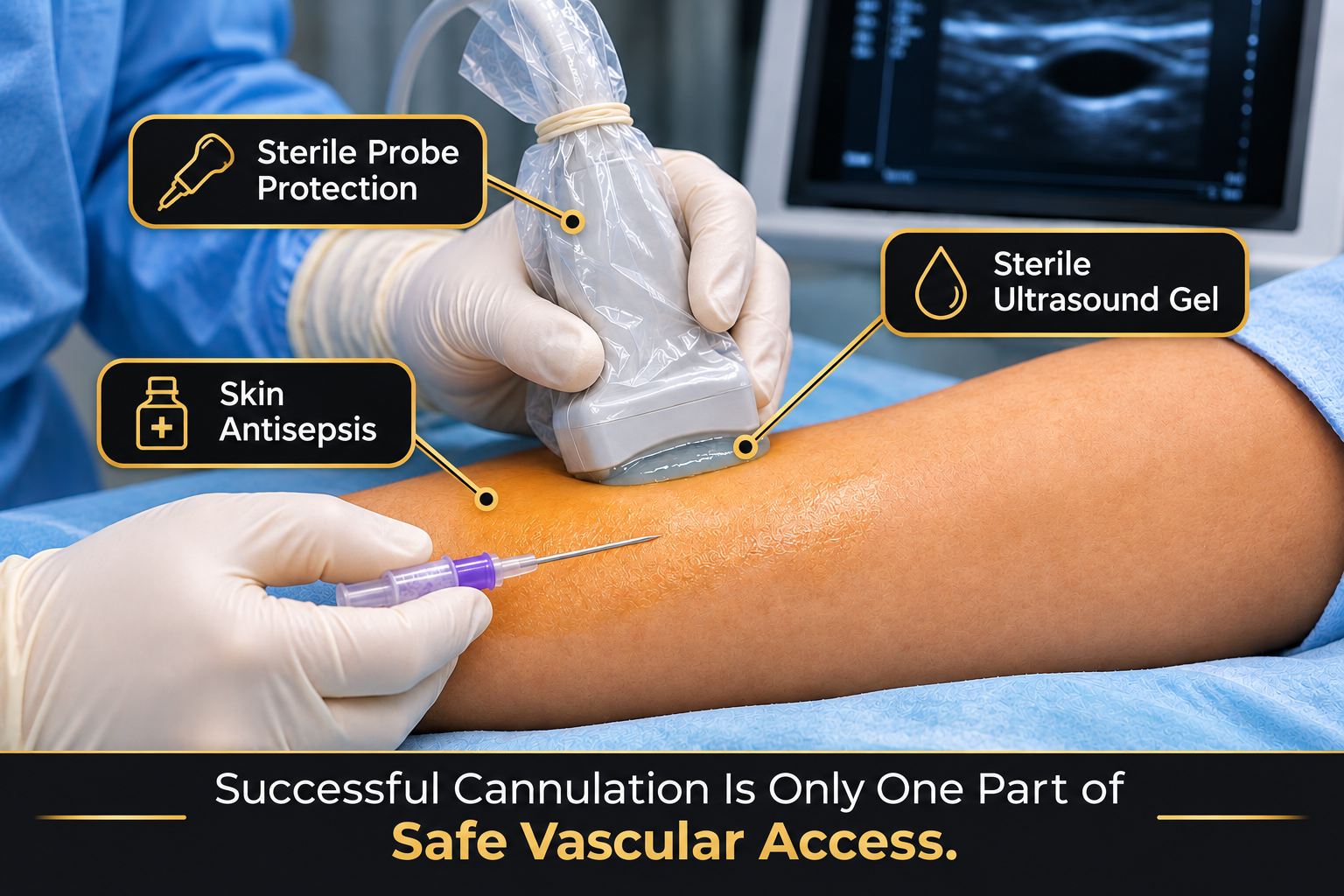
Figure 1. Essential components of ultrasound-guided peripheral IV insertion. AI-generated illustration for Cascade Clinical Education, 2026.
Evidence Spotlight | Cascade Clinical Education
Ultrasound-guided peripheral intravenous (USPIV) insertion has become an increasingly valuable technique for establishing vascular access in patients with difficult intravenous access. As its use expands across emergency departments, vascular access teams, and other clinical settings, an important question emerges: Are clinicians performing the same procedure using consistent, evidence-informed practices?
A 2020 study by Moureau and Gilbert, published in the Journal of the Association for Vascular Access, examined variations in the supplies and techniques used during USPIV insertion. The findings revealed substantial differences in practice, particularly in the use of sterile supplies, ultrasound probe protection, and aseptic technique.
What Did the Study Examine?
Researchers conducted a voluntary, cross-sectional survey in 2019, collecting responses from 1,475 healthcare professionals. Participants included vascular access specialists, emergency department clinicians, and professionals working in other clinical roles.
The survey examined supply selection, procedural practices, and clinicians' perceptions of aseptic technique during USPIV insertion.
The response rate was 5.5%, an important limitation when interpreting the results. Because participation was voluntary and practices were self-reported, the findings may not represent all clinicians performing USPIV procedures.
Nevertheless, the survey offers an informative snapshot of practice variation across clinical settings.
What Were the Most Commonly Reported Practices?
Among respondents answering the relevant survey questions:
PracticeRespondents reporting "always"Chlorhexidine with alcohol for skin antisepsis89%IV start kit65%Nonsterile clean gloves58%Sterile ultrasound gel packets56%Sterile ultrasound probe covers37%Sterile gloves30%
Although chlorhexidine with alcohol was widely used, other practices varied considerably.
Notably, 69% of respondents considered ultrasound probe protection very important, yet only 37% reported always using sterile probe covers.
This discrepancy highlights an important distinction: Recognizing the importance of a practice does not necessarily translate into consistent implementation.
1. Sterile Supplies and Probe Protection: A Significant Area of Variation
One of the most notable findings involved ultrasound probe protection.
Only 37% of respondents reported always using sterile probe covers, while 24% used them sometimes and 39% reported not using them.
Additionally, 31% reported always placing a transparent dressing over the ultrasound probe as a protective barrier.
Gel selection also varied. Although 56% consistently used sterile gel packets, other respondents reported intermittent or no use of sterile gel.
These differences matter because USPIV insertion involves penetration of the skin and vascular system. Maintaining aseptic technique requires attention not only to skin antisepsis but also to the supplies and equipment introduced near the insertion site.
The study raises questions about how institutional policies, available supplies, and clinician education may influence practice consistency.
2. Ultrasound Gel and Dressing Adherence: An Overlooked Concern
Ultrasound gel is essential for image acquisition, but residual gel can interfere with catheter securement and dressing adhesion.
In the survey, 45% of respondents reported experiencing dressing adherence failure associated with inadequate gel removal.
When examined by clinical role, the percentages reporting this problem were:
41% of vascular access specialists
51% of emergency department clinicians
49% of respondents in other clinical roles
These findings highlight an often-overlooked component of USPIV insertion: postprocedural skin preparation and dressing application.
A successfully inserted catheter still requires appropriate stabilization and securement. Residual ultrasound gel may compromise dressing adhesion, potentially affecting catheter stability.
Importantly, these results describe clinicians' reported experiences. The study did not establish a causal relationship between gel residue and specific catheter complication rates.
3. Differences Between Clinical Roles: Why Does Practice Vary?
The researchers identified statistically significant differences in multiple supply-use practices between vascular access specialists, emergency department clinicians, and other healthcare professionals.
Vascular access specialists generally reported more consistent use of sterile supplies than emergency department clinicians.
For example, among respondents identifying as vascular access specialists, approximately 59% reported always using sterile probe covers.
Emergency department respondents were generally less frequent users of sterile gloves and sterile gel packets.
Why might these differences exist?
Potential explanations include variations in departmental policies, training, supply availability, procedural priorities, and clinical workflow. However, the study did not determine which factors caused the observed differences.
This distinction is important. The findings identify variation in practice, but they do not establish that one clinical specialty is inherently safer or more competent than another.
What Does This Mean for USPIV Education?
The study illustrates why standardized, evidence-informed education is important as USPIV insertion becomes more widely performed.
Training should address more than successful vessel cannulation. It should also establish consistent expectations for:
Skin antisepsis and aseptic technique
Sterile ultrasound gel and probe protection
Appropriate equipment and supply selection
Removal of residual gel before dressing application
Catheter stabilization, securement, and ongoing assessment
Structured education can help clinicians understand not only how to perform a procedure, but why individual steps matter.
The 2026 Association for Vascular Access clinical practice guidelines provide a more current framework for evaluating these practices. The 2020 survey should therefore be viewed as a historical assessment of reported practice patterns rather than a measure of current guideline adherence.
The Takeaway
Ultrasound-guided peripheral IV insertion is more than the ability to visualize and cannulate a vein.
It is a procedure that requires consistent attention to aseptic technique, equipment selection, catheter securement, and patient safety.
Moureau and Gilbert's findings demonstrate that substantial practice variation existed among surveyed clinicians in 2019. Although the study cannot determine the causes or clinical consequences of every reported difference, it raises important questions about the role of standardized training and procedural expectations.
The goal of standardization is not simply to make every clinician perform a procedure identically. It is to ensure that essential safety practices remain consistent, regardless of where—or by whom—the procedure is performed.
Reference
Moureau N, Gilbert GE. Survey of ultrasound-guided peripheral intravenous practices: a report of supply usage and variability between clinical roles and departments. J Assoc Vasc Access. 2020;25(3). doi:10.2309/JAVA-D-20-00021
Read the original research: https://doi.org/10.2309/JAVA-D-20-00021
Evidence Spotlight articles are intended for clinical education and discussion. Clinicians should follow current evidence-based guidelines, institutional policies, and applicable professional standards.
