
Research Spotlight | Cascade Clinical Education
Featured Article: Advancing Vascular Access Practice to Include Internal Jugular Central Venous Catheter Insertions
Author: Wayne Teipen, RN, BSN, VA-BC
Publication: Journal of the Association for Vascular Access. 2026;31(2):18–20.
Article Overview
Vascular access teams (VATs) have evolved considerably over the years, expanding beyond peripheral intravenous catheter insertion and maintenance to encompass comprehensive vascular assessment, device selection, complication prevention, and vascular preservation.
In Advancing Vascular Access Practice to Include Internal Jugular Central Venous Catheter Insertions, Wayne Teipen explores whether ultrasound-guided internal jugular (IJ) central venous catheter (CVC) insertion should become an additional responsibility of appropriately trained vascular access clinicians.
The article challenges traditional assumptions about which healthcare professionals perform central venous access procedures, emphasizing the importance of procedural proficiency, standardized practice, and competency-based education.
Expanding the Role of Vascular Access Teams
Historically, IJ central venous catheter insertion has primarily been performed by physicians and advanced practice providers.
However, experienced vascular access clinicians routinely perform ultrasound-guided procedures requiring detailed anatomical knowledge, needle visualization, vessel assessment, and complication prevention.
The author argues that these existing competencies may provide a foundation for expanding VAT responsibilities to include selected nonemergent IJ CVC insertions.
Importantly, this proposed expansion is not intended to replace physician involvement in complex or emergent situations. Rather, it offers a potential approach to improving access to specialized procedural services while allowing other providers to focus on higher-acuity clinical responsibilities.
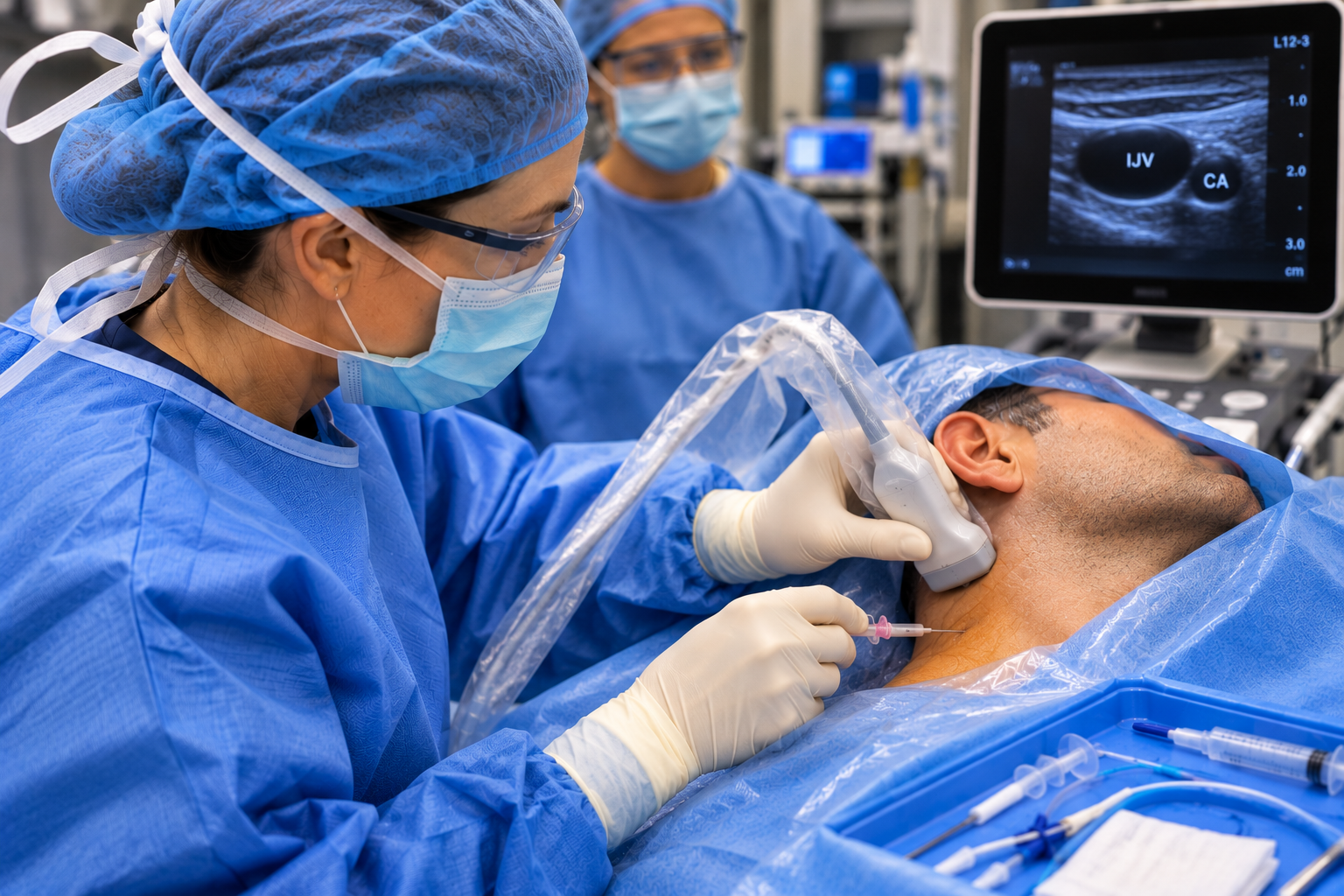
AI-generated illustration depicting ultrasound-guided internal jugular central venous catheter insertion. For educational purposes only.
Patient Safety and Standardized Practice
A central argument of the article is that procedural safety depends on more than professional title or specialty.
Consistent ultrasound proficiency, appropriate patient selection, meticulous sterile technique, and standardized insertion protocols are essential components of safe central venous access.
The author highlights how dedicated vascular access teams may offer advantages through repeated procedural experience, structured workflows, and ongoing quality monitoring.
However, expanding VAT responsibilities requires more than experience with peripheral vascular access.
The article emphasizes the importance of formal education in central venous anatomy, supervised insertions, defined competency benchmarks, institutional credentialing, and continued outcome evaluation.
Potential Benefits for Healthcare Systems
The author identifies several potential operational benefits of VAT-performed IJ catheter insertion, including:
Improved access to clinicians experienced in ultrasound-guided vascular procedures.
Reduced delays associated with scheduling other procedural services.
Fewer patient transfers for selected bedside procedures.
Greater consistency in procedural preparation, infection prevention, and documentation.
More efficient utilization of specialized healthcare personnel.
These potential benefits support consideration of expanded VAT practice models, although implementation and outcomes will depend on institutional resources, clinician competency, and appropriate governance.
CCE Clinical Perspective
The advancement of vascular access nursing should be guided by demonstrated competency, evidence-based education, and patient safety.
As ultrasound-guided vascular access becomes increasingly integrated into nursing practice, opportunities may emerge for appropriately trained clinicians to assume additional procedural responsibilities.
However, technical proficiency with peripheral devices does not automatically establish competency in central venous catheter insertion. These procedures require additional education, supervised clinical experience, and an understanding of their unique risks and complications.
The discussion also raises an important question for healthcare organizations: Are we fully utilizing the expertise of our specialized vascular access clinicians?
Many experienced vascular access nurses already perform central venous access procedures routinely, developing extensive procedural knowledge, technical proficiency, and familiarity with ultrasound-guided techniques. In some settings, these specialized nurses may have greater hands-on experience with particular vascular access procedures than the physicians working alongside them.
This expertise deserves recognition. With appropriate additional education, demonstrated competency, and institutional authorization, experienced vascular access clinicians may be well positioned to expand their practice to include additional types of central venous catheter insertion.
Expanding professional responsibilities should not be viewed simply as increasing the number of procedures a clinician can perform. Instead, it should involve developing structured pathways that support advanced education, competency validation, interdisciplinary collaboration, and safe clinical practice.
Ultimately, the goal is not to replace one professional role with another, but to ensure that patients receive timely, appropriate vascular access from clinicians who are qualified and authorized to provide it.
Clinical expertise should create opportunities for professional growth, supported by education, competency, and accountability.
Reference
Teipen W. Advancing vascular access practice to include internal jugular central venous catheter insertions. Journal of the Association for Vascular Access. 2026;31(2):18–20. doi:10.2309/JVAD-31-2-Deeper-Dive
Read the original article: https://doi.org/10.2309/JVAD-31-2-Deeper-Dive
