
Biplane Ultrasound- Is it worth it?
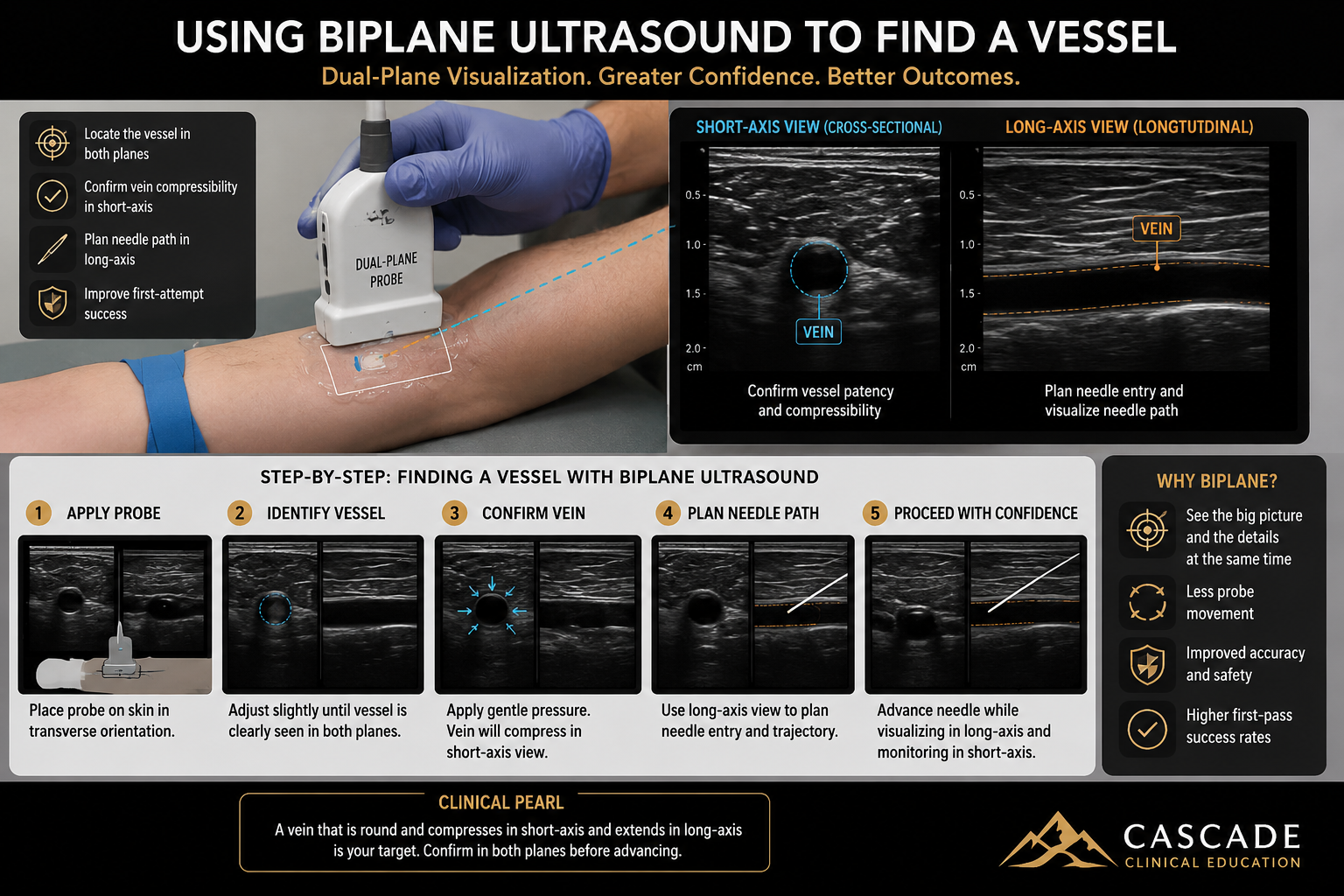
Biplane Confirmation
Is it really necessary?
Point-of-care ultrasound continues to evolve, and one of the newest innovations is synchronous biplane imaging. Unlike traditional ultrasound, which requires the operator to rotate the probe to switch between short-axis and long-axis views, biplane technology displays both views simultaneously. The goal is simple: improve needle visualization while reducing probe manipulation.
What Did the Study Find?
Researchers at the Mayo Clinic compared traditional single-plane imaging with synchronous biplane imaging during ultrasound-guided radial arterial catheter placement.
Surprisingly, providers using biplane imaging:
Took longer to complete the procedure.
Had a lower initial success rate.
Required more attempts for successful placement.
At first glance, these results may seem disappointing—but there's more to the story.
Why Does It Matter?
Most clinicians in the study had little or no experience using a biplane ultrasound probe. Many participants reported that the technology offered better awareness of needle trajectory and vessel position but also acknowledged that the learning curve was significant. Larger probe size, image quality, and unfamiliarity with the device were common challenges.
The authors concluded that successful implementation depends on more than purchasing new equipment. Comprehensive education and guided hands-on practice are essential before clinicians can fully realize the benefits of biplane imaging.
Our Take
At Cascade Clinical Education, this study reinforces something we emphasize in every course:
Technology does not replace technique.
Whether you're using a conventional linear probe or the latest handheld biplane device, success still depends on understanding ultrasound physics, recognizing anatomy, maintaining needle visualization, and practicing consistently.
While new technology is exciting, education remains the foundation of safe and successful ultrasound-guided vascular access.
Reference
Anderson RJ, Daxon BT, Merren MP. Single-Plane Versus Synchronous Biplane Ultrasound Imaging During Vascular Access Procedures: Which Is Better and How Can We Improve? Journal of the Association for Vascular Access. 2024.
