
A clinical pathway
Difficult venous access (DIVA) is more than a procedural inconvenience. Repeated unsuccessful peripheral IV attempts can increase pain and anxiety, contribute to vessel damage, delay medications and diagnostic testing, and potentially lead to escalation to more invasive vascular access.
A study by Sou and colleagues examined what happened when one Australian hospital approached DIVA as an organizational problem requiring a structured clinical pathway, rather than simply relying on repeated attempts by individual clinicians.
Building a DIVA Pathway
The study was conducted at an 877-bed tertiary referral hospital in Sydney, Australia. The organization had identified a recurring problem: patients with difficult vascular access, particularly after hours, were experiencing multiple unsuccessful cannulation attempts while waiting for definitive vascular access.
To address this, the hospital developed a DIVA pathway that incorporated both early escalation and ultrasound-guided peripheral IV placement.
The pathway allowed clinicians to escalate after unsuccessful traditional attempts, but importantly, it could also be activated before any attempts were made when a patient was already known or believed to have difficult access.
That distinction is significant.
A DIVA pathway does not have to begin after multiple failures. Recognizing difficult access early creates an opportunity to change the access strategy before unnecessary punctures occur.
Training the Clinician
The hospital's after-hours clinical support team consisted of clinical nurse consultants and clinical nurse specialists who were trained to perform ultrasound-guided peripheral IV insertion.
Training included:
Didactic instruction
Completion of a learning package and examination
Simulated ultrasound-guided cannulation
Supervised clinical USGPIV insertions
Competency development before independent practice
Credentialing was based on both trainer and learner confidence with the skill, which occurred after an average of approximately 15 successful ultrasound-guided cannulations.
Once again, the intervention was not simply providing an ultrasound machine. It involved developing clinicians capable of using the technology effectively.
What Happened?
Between January and December 2016, 379 patients were referred to the after-hours team for ultrasound-guided peripheral IV placement.
Before referral, patients had experienced a median of 2 unsuccessful cannulation attempts, with some experiencing as many as 10 attempts.
Once the trained after-hours team became involved:
93% of patients received successful vascular access on the first attempt.
The median number of attempts decreased from:
2 attempts before referral → 1 attempt with the ultrasound-trained team
No patient required more than two attempts by the after-hours team.
The Patient Experience Changed Too
One of the most striking findings wasn't procedural—it was the difference in reported pain.
Before referral, the median pain score associated with previous cannulation attempts was:
7/10
With ultrasound-guided cannulation by the trained team:
2/10
The difference was statistically significant (p < .001). Nearly one-quarter of patients had reported pain scores of 10/10 during attempts performed before ultrasound-guided escalation.
That matters.
Reducing unsuccessful attempts isn't simply about procedural efficiency. Every avoided attempt potentially represents less pain, less anxiety, and less additional vascular trauma for the patient.
Vessel and Device Selection Were Part of the Strategy
The pathway extended beyond the question of “Can we get an IV?”
The hospital also developed a vascular-device decision algorithm that considered therapy, anticipated duration, vascular assessment, and appropriate device selection. The article's second flowchart on page 4 illustrates this broader approach.
The basilic vein in the upper arm was used for approximately 69% of cannulations, and the minimum catheter length reported was 45 mm. The authors suggest that access to deeper upper-arm vessels and longer devices may have expanded options for patients whose traditional superficial access had become inadequate.
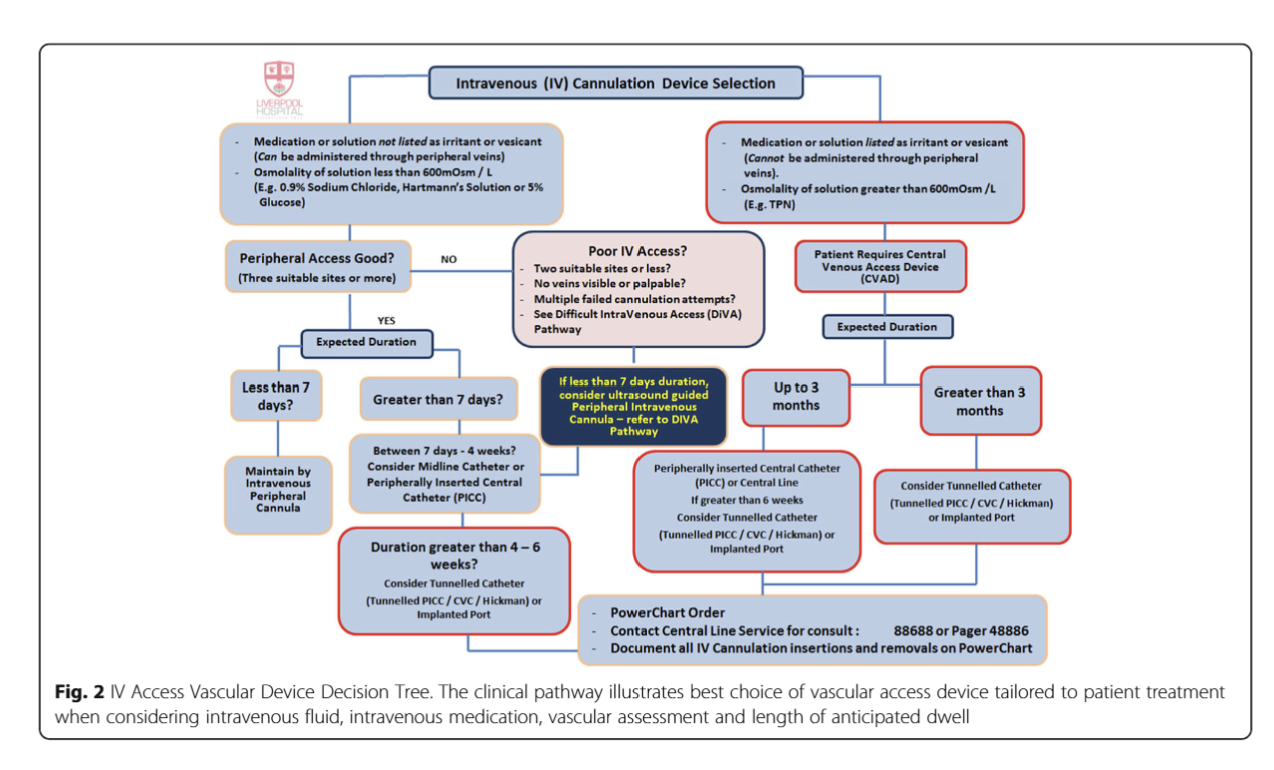
Device Selection
Why the After-Hours Component Matters
The hospital already had a central vascular access service. The problem was that the specialized service couldn't realistically provide timely coverage for the entire hospital—particularly after hours.
Instead of trying to make one specialized team available everywhere, the organization expanded capability by training another group of clinicians.
The result was an escalation pathway capable of bridging the gap until definitive vascular access could be obtained when necessary.
That is an important lesson for hospitals with limited vascular-access resources:
Access to expertise does not necessarily require having a dedicated vascular access specialist physically available 24/7. Developing competency within existing clinical teams may provide another model.
Limitations
This was an inception cohort study rather than a randomized controlled trial, so the results demonstrate the experience of this particular program and cannot establish that every improvement was caused by ultrasound or the pathway itself.
Not every patient with DIVA at the hospital was referred to the after-hours team, and other services—including anesthesia and the hospital's central vascular access service—continued to provide access for some patients.
Pain scores from attempts occurring before referral were also subject to recall bias.
The results therefore shouldn't be interpreted as evidence that an identical pathway would produce the same outcomes in every institution.
Practice Takeaway
The most important intervention in this study may not have been ultrasound itself.
It was creating a system around difficult vascular access.
Early identification.
Defined escalation.
Appropriate device selection.
Trained clinicians.
Ultrasound capability.
Vessel preservation.
Together, those elements helped transform DIVA from a series of repeated attempts into a clinical pathway.
For organizations developing vascular access programs, the question may therefore need to evolve from:
“Who can get this IV?”
to:
“What system do we have in place when vascular access becomes difficult?”
APA 7 Reference
Sou, V., McManus, C., Mifflin, N., Frost, S. A., Ale, J., & Alexandrou, E. (2017). A clinical pathway for the management of difficult venous access. BMC Nursing, 16, Article 64. https://doi.org/10.1186/s12912-017-0261-z
